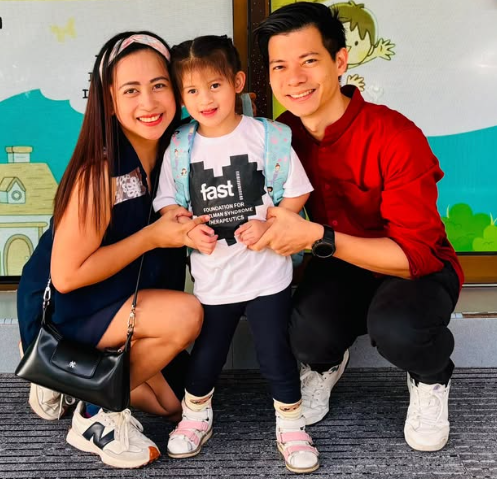
Alexandra – Angelman Syndrome
Profile
Name: Alexandra
DOB: Year 2022
About the disorder
General
- Neuro disorder caused by UBE3A gene being missing or damaged. This gene helps brain cells connect and communicate
Key Features
- intellectual delay
- stiff, jerky gait
- lack of speech
- happy demeanour: frequently smiling and laughing
Physiological features
- wide mouth, wide spaced teeth
- prominent or protruding jaw
- Lighter-colored skin, hair, and eyes compared to other family members or the rest of the household
Key Challenges
- Body balance, movement stability
- Speech, learning difficulties
Key Medical Treatment
- Physiotherapy
- Gene therapy clinical trial ongoing
A Journey that found Purpose
People often ask us what it is like to have a daughter with a rare disease.
The truth is, we never set out expecting our story to be different from any other family’s. Like every new parent, we dreamed about Alexandra’s first words, her first steps, her first day of school, and the life that lay ahead of her.
But life had a different plan.
As the months went by, we began noticing that Alexandra was not reaching the developmental milestones other children her age were achieving. She was delayed in sitting, crawling, and communicating. Every appointment seemed to bring more questions than answers. We met different specialists, underwent numerous assessments, and held on to the hope that the next test would finally tell us something we could fix.
Genetic Testing revelation
Eventually, genetic testing gave us the answer: Alexandra has Angelman syndrome, a rare neurogenetic disorder caused by the loss of function of the UBE3A gene in the brain, affecting development, movement, communication, and learning.
Receiving the diagnosis was both devastating and relieving. Devastating because it forced us to let go of many expectations we had quietly built as parents. Relieving because, for the first time, we understood what we were facing and could begin learning how to help her. Like many families, we grieved — not because we loved Alexandra any less, but because we had to mourn the future we had imagined before embracing a different one.
Over time, our perspective began to shift. We stopped asking “Why us?” or “What is wrong?” and started asking, “How can we help Alexandra live her fullest life?”
That question has guided our family ever since.
New Path
Like many parents of children with rare diseases, our lives quickly became filled with therapy sessions, medical appointments, paperwork, and a completely new language of genetics, rehabilitation, and developmental care. Progress often came in tiny steps. Milestones that many families celebrate once became victories we fought hard for over months or even years — a new skill, a successful therapy session, a better night’s sleep, a moment of connection.
Yet those small victories became some of the biggest celebrations of our lives.
Alexandra has taught us that progress should never be measured by comparison with others. Every child has their own journey, and every achievement deserves to be celebrated. She has taught us patience, resilience, and gratitude in ways we never imagined — reminding us daily that a meaningful life is measured not by how quickly milestones are reached, but by the love, determination, and hope shared along the way.
Perhaps the biggest surprise was discovering that we were not alone.
Through Malaysia Rare Disorder Society (MRDS), Angelman Syndrome Malaysia, clinicians, therapists, researchers, and fellow parents, we found a community that understood both the challenges and the hopes that come with living with a rare disease. We met families who had walked this path before us and were generous enough to guide those who came after. What once felt like an isolating diagnosis became a shared journey.
As we learned more about Angelman syndrome, we also discovered something that filled us with hope: a global community of scientists, clinicians, and advocates working tirelessly to develop treatments that address the root cause of the disorder. Researchers are using patient-derived cells, organoids, animal models, biomarkers, and natural history studies to better understand the condition and evaluate potential therapies. For the first time in history, treatments targeting the underlying genetic cause of Angelman syndrome are being developed — and clinical trials are no longer a distant dream. They are happening today.
For families like ours, research is not an abstract scientific pursuit. It represents possibility.
Every natural history study that families participate in helps establish the baseline against which future treatments can be measured. Every biomarker discovered helps researchers understand whether a therapy is working. Every researcher, clinician, volunteer, donor, advocate, and participating family contributes another piece of the puzzle.
Hope is built one study at a time.
That is why we believe awareness and advocacy matter just as much as research itself. Rare diseases may be individually uncommon, but together they affect millions of people around the world. Earlier diagnosis, better access to care, stronger support systems, and continued investment in research all begin with greater public understanding.
Purpose
Today, our family chooses to be part of that effort. We share Alexandra’s story not because it is unique, but because there are many other families quietly walking similar paths. We hope that by speaking openly, we can help shorten someone else’s journey to diagnosis, encourage participation in research, and remind newly diagnosed families that they are not alone.
Alexandra may have a rare condition, but she is first and foremost our daughter. She is full of joy. She has shown us that while rare diseases can change the direction of a family’s journey, they do not have to define its destination.
Our journey did not become easier after her diagnosis. It became more meaningful.
And while we cannot predict what tomorrow holds, we remain hopeful that through science, advocacy, collaboration, and the unwavering determination of families around the world, the future for children with rare diseases will be brighter than it has ever been before. Alexandra is the reason we believe that hope is not simply something we feel. It is something we build together